Patch Perfect: Catching amblyopia early with school screening

Jasper

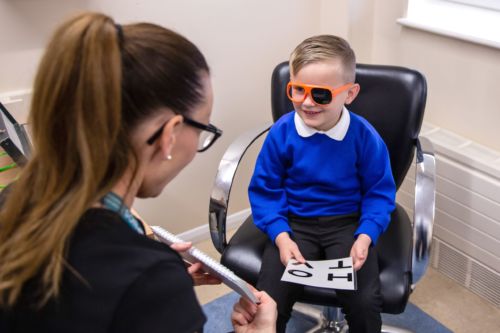
Six-year-old Jasper’s parents had no idea there was anything up with his eyesight until school vision screening picked up that he had low vision in one eye. Jasper has Amblyopia, often referred to as “lazy eye”, which is a condition where the vision in one eye doesn’t develop correctly, leading to uneven vision.

Jasper, an imaginative child who loves arts and crafts, building train tracks, and constructing cardboard creations, didn’t show any signs that he was struggling.

“If it wasn’t for that school screening, I don’t think we would’ve picked it up as early,” said his dad, Sun. “His reading was always very good, so he was overcompensating quite a bit with his right eye. When we first went to the hospital and did the eye test with the chart, I thought gosh, this will be a big issue if it’s not sorted out.”

After being referred to an orthoptist and hospital optometrist, Jasper was prescribed glasses and began wearing a patch over his stronger eye to stimulate the weaker one. He quickly took to it, despite some initial discomfort. “He’s very compliant,” said his parent. “The patches come in all kinds of different designs and colours. When we went back for a follow-up, he got to pick a box of designs. He’ll say, ‘I don’t want to wear the puppy today, I want to wear the rocket,’ so he gets a choice and has some control.”

Erick Wilson-Gougeon, a Family Outreach Officer from Guide Dogs, was one of the people Jasper saw when he came into the hospital. “While Jasper didn’t need much additional support, amblyopia isn’t always caught so early. For children who need a little bit of further support, there is support available, whether that be information, access to our CustomEyes books with a larger typeface, or even signposting on to further services.

“We want parents to know that regardless of their children’s level of vision we can help.”

Alis Sejourne, from the British and Irish Orthoptics Society, as well as Jasper’s Orthoptist, advocates for mandatory school screening to help children like Jasper: “Amblyopia is a condition where one eye doesn’t develop vision properly and affects up to 5% of children in the UK. Patching is a highly effective treatment, where the stronger eye is covered with a patch or blurred with eye drops to encourage the weaker eye to work harder and strengthen. Without early intervention, amblyopia can lead to permanent but preventable reduced vision.

“Catching amblyopia through school vision screening and timely support from orthoptists is crucial. However, not all children currently have access to school vision screening across the UK, and patching can be challenging for both children and parents. That’s why we’re calling for compulsory national screening and highlighting the support available through the BIOS #WePatch campaign.”

If your child has been diagnosed with a visual impairment and you’d like to find out more about the support and resources available to you, visit guidedogs.org.uk or call 0800 781 1444.

Find out more about our #WePatch campaign and how you can support the call to make school screening mandatory.
Bookmark 1

No account yet? Register

BIOS launch survey on child vision screening services

Close up of child's eyes and nose.

Today, we’ve launched a crucial service evaluation to assess the current state of child vision screening in the UK and Ireland. This has been sent out to all heads of service across the UK, but we encourage responses from all orthoptists.

The current landscape of child vision screening is fragmented, and a unified dataset is required to drive systemic improvements. This strategic data collection is vital for understanding existing clinical practices and shaping future policy decisions.

The primary objectives are to generate data that provides a comprehensive overview of:

  1. Current clinical protocols, referral pathways, and quality-assurance methods.
  2. Map the overall provision across the UK and Ireland
  3. Highlight barriers related to staffing, training, and service sustainability.

This service evaluation is being conducted as part of a research project led by Dr Cath Jukes. The aim of this BIOS project is to gather compelling information and develop proposals to support the creation of an equitable, high-quality nationwide vision screening program.

This is an opportunity for orthoptists to actively shape the future of eye care for children. Please help us advocate for the quality and accessibility of child vision screening services by taking part.

Bookmark 1

No account yet? Register

BIOS survey shows 75,000 children a year miss out on in-school vision screening

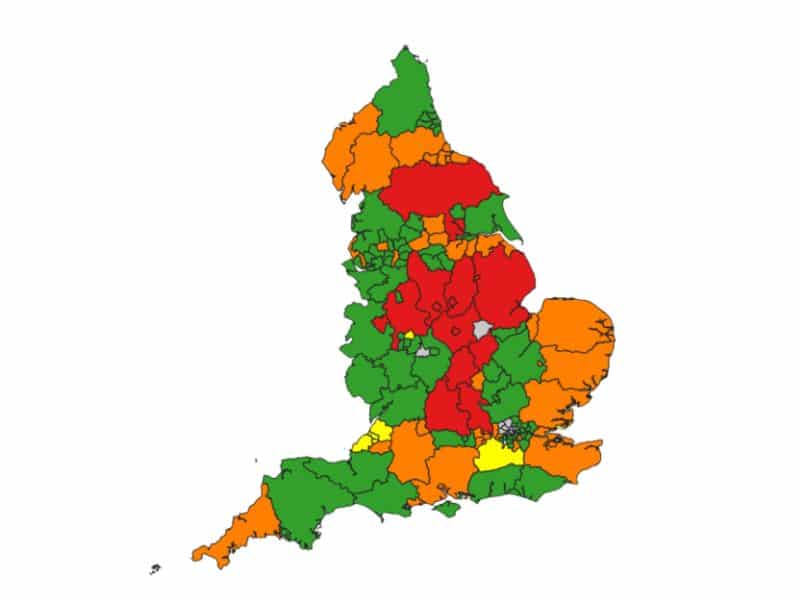
Colour coded map of England showing visions screening services by local authority.

The results of our survey of child vision screening services in England show a concerning rise in the number of local authorities not offering any form of reception-age screening.

Since 2019, when we last surveyed services across England, a further five local authorities have decommissioned child vision screening, meaning that 14 no longer offer this service, affecting around 75,000 reception-aged children every year. There is a risk this could result in visual defects in children going undetected and potentially becoming irreversible. In addition, undetected vision problems can prevent children from fully accessing their education

Equitable population vision screening, organised and led by an orthoptist, is recommended by the UK National Screening Committee and in the Public Health England guidance from 2017. Orthoptist-led child vision screening primarily aims to pick up Amblyopia, where the vision in one or both eyes doesn’t develop properly.

It is estimated that 1 in 50 children will develop this condition but it is rare for children to complain of poor vision, particularly if it only affects one eye, meaning this can easily go unnoticed. Reduced vision can have an impact on a child’s learning and development. Vision continues to develop in children until around eight years of age, therefore early detection and treatment helps avoid permanent visual impairment.

  • 57% of local authorities have orthoptic-led vision screening following PHE guidelines

  • 33% of local authorities have vision screening services that do not follow PHE guidelines (29%) or did not confirm whether or not they follow PHE guidelines (4%)

  • 10% of local authorities do not have any form of vision screening for 4-5 year olds

Of the 138 local authorities we received details on, 56.6% were covered by child vision screenings services that followed guidelines set out by Public Health England A further 33.3% of local authorities offered screening services that either did not follow these guidelines or we were not able to confirm whether they followed.

While the UK government, responsible for health policy in England, accepts the need for Orthoptic-led vision screening, they have not made this mandatory, unlike other forms of screening. This is in spite of the UK National Screening Committee of Public Health England recommending orthoptic-led screening for all 4-5 year olds.

This survey highlights the need for a nationwide mandatory orthoptic-led child vision screening programme. This would address the existing health inequalities in this vital area of a child’s development.

This has led to large inconsistencies in the availability of vision screening across England. Significant financial constraints and the lack of a mandate for vision screening has meant increasing numbers of local authorities decommissioning services. There is also some confusion as to who should be ensuring these services are provided.

As Health is devolved, the situation in Scotland, Wales and Northern Ireland is much more promising with all three countries offering nation wide programmes, demonstrating the feasibility of a nationwide approach.

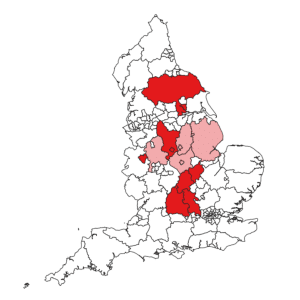
Map of England, split by local authority, showing changes in the number of local authorities without visions screening since 2019.

Map showing child vision screening services decommissioned since 2020 (red), alongside services that did not exist in 2020 (pink)


BIOS advocates for a mandated orthoptic-led national screening programme in England, to ensure all children receive the same care when they need it, regardless of where they live.

Find out more about our campaign

Bookmark 1

No account yet? Register

Child Visions Screening Survey – Deadline Extension

Child-Vison-Screening-survey-1-e1707472471988

We’re currently surveying all orthoptic departments in England to allow us to establish the current provision of ‘orthoptic-led’ and ‘non-orthoptic-led’ child vision screening.

In 2019, we carried out a Freedom of Information request of local authorities and CCGs, alongside the Clinical Council for Eye Health Commissioning (CCEHC), to establish a picture of services across England, the results of which were published in 2020, and are available here. It is important that we now update these findings to ascertain how service provision has changed in the intervening years, particularly in the aftermath of the COVID-19 pandemic.

https://www.orthoptics.org.uk/wp-content/uploads/2024/02/Child-Vison-Screening-survey-1024×576.png

All Heads of service or orthotopic leads in England will have received an email with a link to our survey within the last fortnight. If you haven’t received this, please get in contact at r.huzzey@orthoptics.org.uk.

Many thanks for providing this information, it will be extremely useful to support the objective of delivering equitable orthoptic-led vision screening for ALL 4–5-year-old children by mapping out current provision.

Bookmark 0

No account yet? Register

Proposal to standardise services to support children with reduced vision during in-school screening

IMG_8165-scaled-e1584538955444

The Clinical Council for Eye Health Commissioning (CCEHC) recognises variation in service provision and availability for children with vision deficit picked up through school vision screening in England.

The Post-Vision Screening: Proposals and Recommendations report delivered by the multi-disciplinary Working Group of the CCEHC, identified inconsistent services and pathways linking children who screen positive for vision impairment during their school assessments to ongoing care with specialist diagnostic and clinical management services. While a number of local pathways have been developed in parts of the country to provide follow-on care, there are variations in how these are commissioned and delivered, their outcomes, and governance arrangements.

The CCEHC’s report provides commissioners and policy makers with over-arching principles for post-vision screening services, and proposals for high-level requirements to deliver an accountable service.

Recommendations include:

  1. A dedicated post-vision screening service should be commissioned for children who screen positive following their vision screening assessment.
  2. The delivery of services through locally agreed pathways and governance processes, and the development of locally agreed service specifications for commissioning.

Parul Desai, Chair of the CCEHC Vision Screening Working Group, said:

“This report has highlighted a gap in service provision, and its recommendations serve to address it. Their implementation would provide assurance to parents of the care they should expect if their child screens positive following a vision screening assessment, and form the basis for local discussions amongst commissioners, clinicians and provider organisations on how best to deliver it.”

Wojciech Karwatowski, Chair of the CCEHC and Zoe Richmond, Vice-Chair of the CCEHC, said:

“Once again, the CCEHC has produced a report and recommendations which facilitate the understanding of local need and design of service provision by commissioners and providers.

The CCEHC encourages commissioners to ensure these recommendations are used to review existing arrangements and support the development of new services where they currently do not exist. Once implemented, this will serve to provide consistency in the quality and effectiveness of the care provided.”

https://www.orthoptics.org.uk/wp-content/uploads/2020/03/IMG_8165-scaled-e1584538955444.jpg

If you are interested in finding out more:

Read the full report here

Read more about the CCEHC

Find out more about orthoptic vision screening from our CAG.

Bookmark 0

No account yet? Register

Vision Screening CAG Update

BIOS British and Irish Orthoptic Society. Logo includes eye in brand colours.
Hello to all BIOS members, my name is Asad Atiq and I am happy to announce that I have joined the vision screening CAG steering group as the new co-lead. I will be working closely with Karon McCarthy who is the current lead, and I am looking forward to continuing the hard work that has been devoted to vision screening by the previous and current members of the CAG steering over the years.

Karon and I would like to highlight some of the work of the CAG steering group and BIOS, that has been going, and is continuing behind the scenes

·         Development of a multi-disciplinary post screening pathway,

·         Development of PHE standards,

·         Annual audit of vision screening data

·         Responding to queries from BIOS members.

During the Covid-19 pandemic we have received many queries from members regarding vision screening and to help our members we compiled resources that could be used during these uncertain times. With BIOS we have recently published recommendations on dealing with the vision screening backlog with the Clinical Council for Eye Health Commissioning (CCEHC). Going forward we are continuing our work with formulating a recovery plan for vision screening post covid-19.

We have much work to do, but we are steadily making progress on our long-term goal of getting an orthoptic-led national standardised screening programme in England, to reduce health inequalities and to enable all children to receive the same care, regardless of where they live. To help us to achieve this goal we would like to take this opportunity to ask for new members to join our vision screening CAG steering group – please see advertisement for details on how to join.

We would like to wholeheartedly thank the vision screening CAG steering group and the support from Jigs Mehta and Julie Downdey in promoting vision screening and working towards the goal.

We would also particularly like to thank two members of the group who have sadly stepped down fron their roles within vision screening Alison Bruce and Helen Griffiths.

Alison stepped down as co-lead in September 2020 having worked as part of the CAG steering group for over 8 years, and over 3 as co- lead. Alison’s work demonstrating the educational impact of wearing glasses has, and continues to, support the case for nationalised vision screening programme.

Helen, who stepped down from the steering group in February 2021 worked tirelessly VS CAG for over 10 years with 6 of them as lead. She gained Public Health England interest in vision screening and was pivotal in developing the resources for commissioning and providing vision screening.

Helen has recently published the latest BIOS vision screening audit for the academic year 2018-2019. This audit as well as all previous years can be found in the members section on the BIOS vision screening CAG webpage.

Both of these ladies have made an enormous contribution to national vision screening and we are truly grateful for their work and wish them well for the future.

We will continue to provide regular updates of the work we are doing but for now take care and stay safe.

Asad Atiq and Karon McCarthy

Bookmark 0

No account yet? Register

Recommendations for the Immediate Management of the Child Vision Screening Backlog for 2019/20 and 2020/21 in England

IMG_8179-scaled-e1612960237805

The Clinical Council for Eye Health Commissioning (CCEHC), of which BIOS is a member, has today published recommendations for children who have missed out on vision screening due to the COVID-19 pandemic.

COVID-19 has caused major interruptions in education and child health services. This has meant that Child Vision Screening services have been delayed, postponed or cancelled for some of the children who started Reception Year in 2019 (and possibly some who started in 2020), resulting in a backlog of children who have not been screened. The primary aim of Child Vision Screening is to identify all children aged 4 to 5 years with impaired sight and enable timely intervention. 

The Clinical Council for Eye Health Commissioning (CCEHC) is aware of a number of issues around restoring and providing these screening services in England. It recognises that the immediate and current challenge is the timely management of the backlog of children who have missed their screening opportunity at school; and that the priority is to put in place measures for children who commenced Reception year in 2019/20.  As a means for managing this backlog, the CCEHC has made recommendations for alternative, failsafe arrangements for these children to have their vision tested:

CCEHC Recommendations for Vision Screening backlog 2021

Template Letter to Parents

These recommend that parents should be advised to arrange for a NHS sight test with a local optometrist of their choice, if their child entered Reception in 2019 and has not yet been screened at school. The Council is also calling for good liaison between all those involved in Child Vision Screening  (i.e. Screening Providers, Local Optical Committee clinical leads, Specialist Eye Service Provider’s Orthoptic / Optometric leads and Screening Service Commissioners), for  planning and implementing these failsafe recommendations and ensuring that eligible children are identified, tested and appropriately managed until routine screening services are restored.

https://www.orthoptics.org.uk/wp-content/uploads/2021/02/IMG_8179-scaled-e1612960237805.jpg

If you are interested in finding out more:

Find out more about our campaign calling for an orthoptic-led national screening programme in England.

Visit our Vision Screening CAG page for more information on orthoptic-led screening.

About the Clinical Council for Eye Health Commissioning (CCEHC)
The CCEHC represents all the leading clinical professions and charity organisations in the eye-care sector. It is an independent advisory body providing evidence-based national clinical leadership, advice and guidance to policy makers in health, social care and public health, and those commissioning and providing eye health services in England. It is recognised as such through a Memorandum of Understanding with NHS England.

Our recommendations are supported across the eye health services sector.

Further details on our member organisations and work can be found here.

Child Vision Screening
The UK National Screening Committee recommends orthoptic-led screening to detect reduced vision for all 4-5-year old children at school entry, to ensure that any problems that can be treated are identified and that a child’s vision develops normally1.  Children can often cope very well with some eye problems and may go unnoticed by the child, parents or anyone else, so even children with apparently normal vision should be tested.  Screening is usually carried out at school.

  1. UK National Screening Committee.  Screening for vision impairment for 4-5-year old children.
Bookmark 0

No account yet? Register

Child Vision Screening – FOI Results Published

IMG_8165-1-scaled-e1584539044120

Child vision screening 2019 – services are available but still work to do!

Orthoptic-led child vision screening aims to pick up amblyopia (commonly known as “lazy eye”), where the vision in one or both eyes does not develop properly. It is estimated that 1 in 50 children will develop this condition. Often younger children are unaware there is anything wrong with their vision, as they have grown up with and become used to it. If undetected, the condition can result in lifelong and irreversible reduced vision in the affected eye.

A Freedom of Information (FOI) in request in 2019 by the British and Irish Orthoptic Society (BIOS), on behalf of the Clinical Council for Eye Health Commissioning (CCEHC) shows that some form of vision screening is currently available in 94% of local authority areas in England, commissioned either by the Local Authority (LA) or by the local Clinical Commissioning Group (CCG).

However, there are variations in the delivery and quality assurance of vision screening services with only 47% of local authority areas fully compliant with service specifications recommended by Public Health England (PHE).  65% of areas providing the service had some processes in place for monitoring uptake of screening.

Where services do exist, some responses indicate they may be vulnerable to changing priorities and funding cuts, with six LAs reporting that their services were currently being reviewed, with the potential for them to be decommissioned.

Commenting on the findings:

Alison Bruce, co-lead of the vision screening clinical advisory group of BIOS said: “Screening to detect reduced vision at school entry should be available to all children no matter their socio-economic or ethnic background. It provides the opportunity to treat visual deficits that can impact on future life chances.”

Parul Desai Chair CCEHC and Veronica Greenwood Chair BIOS – “Given the current financial constraints, the CCEHC welcomes the wider availability of child vision screening services in England.  The focus should now be on ensuring that services compliant with PHE specifications are provided in all areas to address any disparities in service availability, quality and outcomes.”

  • You can read the full report here.
  • BIOS have created an interactive map, presenting the current level of service availability, which can be accessed here.

https://www.orthoptics.org.uk/wp-content/uploads/2020/03/Map-e1583323632757.png

If you are interested in finding out more:

The full report can be downloaded here.

Access our interactive map here.

Read more about BIOS’s campaigning on vision screening here.

Bookmark 0

No account yet? Register

Brand new video for World Orthoptic Day 2019

Video-e1559494047746

To mark World Orthoptic Day 2019, we are pleased to announce the launch of a new video explaining a little about the work that Orthoptists do.

This year, Orthoptist Martha Waters discusses the importance of vision screening in uncovering amblyopia in children. She then explains what amblyopia is, describing how it can be treated by an orthoptist and the profound effect this can have on a child’s vision..

https://www.orthoptics.org.uk/wp-content/uploads/2019/05/WOD_Logo_CMYK_with_date_2019_square-e1558615511862-1024×658.jpg

You can find out more about orthoptics in our public information section

Find out about our My Eyes My Orthoptist Campaign, also launching on World Orthoptic Day

Find out about our campaign to ensure that all children in the UK receive vision screening in school here

Previous videos for World Orthoptic Day:

WOD 2017 – What does an Orthoptist do?

WOD 2018 – What is orthoptics?

For more information about orthoptics and what orthoptists do, go to our public information pages.

Bookmark 0

No account yet? Register

World Orthoptic Day 2019

WOD_Logo_CMYK_with_date_2019_square-e1558615572316

On the first Monday in June every year, IOA World Orthoptic Day is the opportunity to heighten the visibility of the orthoptic profession and to promote the activities of orthoptists locally, nationally, and internationally.

This year as always BIOS will take this opportunity to increase awareness of the valuable work being done by Orthoptists.

  • This year sees the launch of our long-awaited #MyEyesMyOrthoptist campaign, aiming to promote a greater awareness of the vital role of Orthoptists.
  • The IOA will be running their much loved annual orthoptic-selfie competition.
  • We will be releasing a new educational video on amblyopia and the importance of vision screening.
  • We will also be active on social media throughout the week. Please do follow us on Twitter and Facebook and let us know what you’re doing this World Orthoptic Day.

Most of all, get involved and make sure you’re telling people about orthoptics!

https://www.orthoptics.org.uk/wp-content/uploads/2019/05/WOD_Logo_CMYK_with_date_2019_square-e1558615511862-300×193.jpg

Interested in getting involved?

Find out about our My Eyes My Orthoptist Campaign, launching on World Orthoptic Day

Read more about our policy and campaigns work here.

Please note that unfortunately the world record attempt in Liverpool on 3 June has had to be postponed until next year. We’re sorry for any inconvenience.

The International Orthoptic Association (IOA) is the global voice of the orthoptic profession, which internationally is made up of 15 member national professional organisations and 6 associate member organisations. Find out more on their website.

Bookmark 0

No account yet? Register